


Pre-War Apartment Details Worth Saving (and How to Integrate New Finishes)
Last Updated:
September 20, 2026
Pre-war apartments in New York City (those typically constructed between 1900 and 1940) possess an architectural DNA that is increasingly rare in today’s glass-and-steel landscape. For the discerning homeowner, the challenge of a pre-war apartment renovation lies in striking a delicate balance between honoring the past and accommodating a modern lifestyle.
At LSB Interior, we view these spaces through the lens of Parisian elegance, where the goal is not to erase history, but to curate it. By identifying which original moldings and structural features to save, and knowing exactly how to integrate new finishes, you can create a residence that feels both storied and fresh.
This guide explores the essential pre-war details worth saving and the design strategies required to bring them into the 21st century.


In the context of NYC real estate, "pre-war" is more than a chronological distinction; it is a mark of quality. These buildings were constructed during an era when craftsmanship was prioritized, and materials like solid oak, thick plaster, and hand-forged brass were standard. For a homeowner embarking on a renovation, these details are the "bones" of the home. Removing them entirely often results in a "white box" that feels disconnected from its environment.
When we approach a pre-war apartment renovation, our philosophy is rooted in "Modern Livability." This means we don't treat the apartment like a museum. Instead, we use the original architecture as a sophisticated backdrop for contemporary art, streamlined furniture, and state-of-the-art technology.
Before the demolition crew arrives, it is vital to audit the existing elements. Not every old feature is worth saving, but the following are generally considered the "crown jewels" of NYC pre-war architecture.
Unlike modern crown moldings made of MDF or foam, pre-war moldings were often hand-applied plaster. They possess a depth and "softness" of edge that cannot be replicated with modern machinery.
The durability of old-growth wood is unparalleled. Many pre-war apartment renovations feature intricate herringbone or chevron patterns with mahogany ribbon inlays.
Common in Art Deco-era buildings (1930s), sunken living rooms create immediate visual interest and define "zones" without the need for walls.
Pre-war doors are often two inches thick and made of solid wood, providing excellent acoustic insulation. The hardware, often brass or glass, carries a weight and patina that feel substantial.
Steel-framed casement windows are iconic features for homes in New York City. Transom windows (the small windows above doors) were originally designed for airflow but now serve as beautiful light-transmitting elements.
The secret to a successful renovation is knowing where to be bold with new finishes. To achieve that sought-after Parisian elegance, we recommend the following integrations:
The kitchen is where most homeowners want total modernization. To integrate this into a pre-war space, avoid "traditional" cabinetry that tries to mimic the 1920s. Instead, go for ultra-modern, flat-panel cabinetry in a sophisticated palette like charcoal, navy, or cream. Pairing these sleek lines against original moldings creates a stunning visual dialogue.
Lighting is the quickest way to modernize a pre-war apartment. Replace "period-appropriate" chandeliers with oversized, sculptural contemporary fixtures. A sleek, blackened steel mobile or a minimalist glass orb pendant suspended from an ornate plaster ceiling medallion is the epitome of modern livability.
Pre-war bathrooms were often small. In a renovation, we often expand the footprint but keep the material palette classic.
A pre-war apartment renovation in NYC involves more than just design. A co-op renovation in NYC requires navigating Co-op boards and the Department of Buildings (DOB).
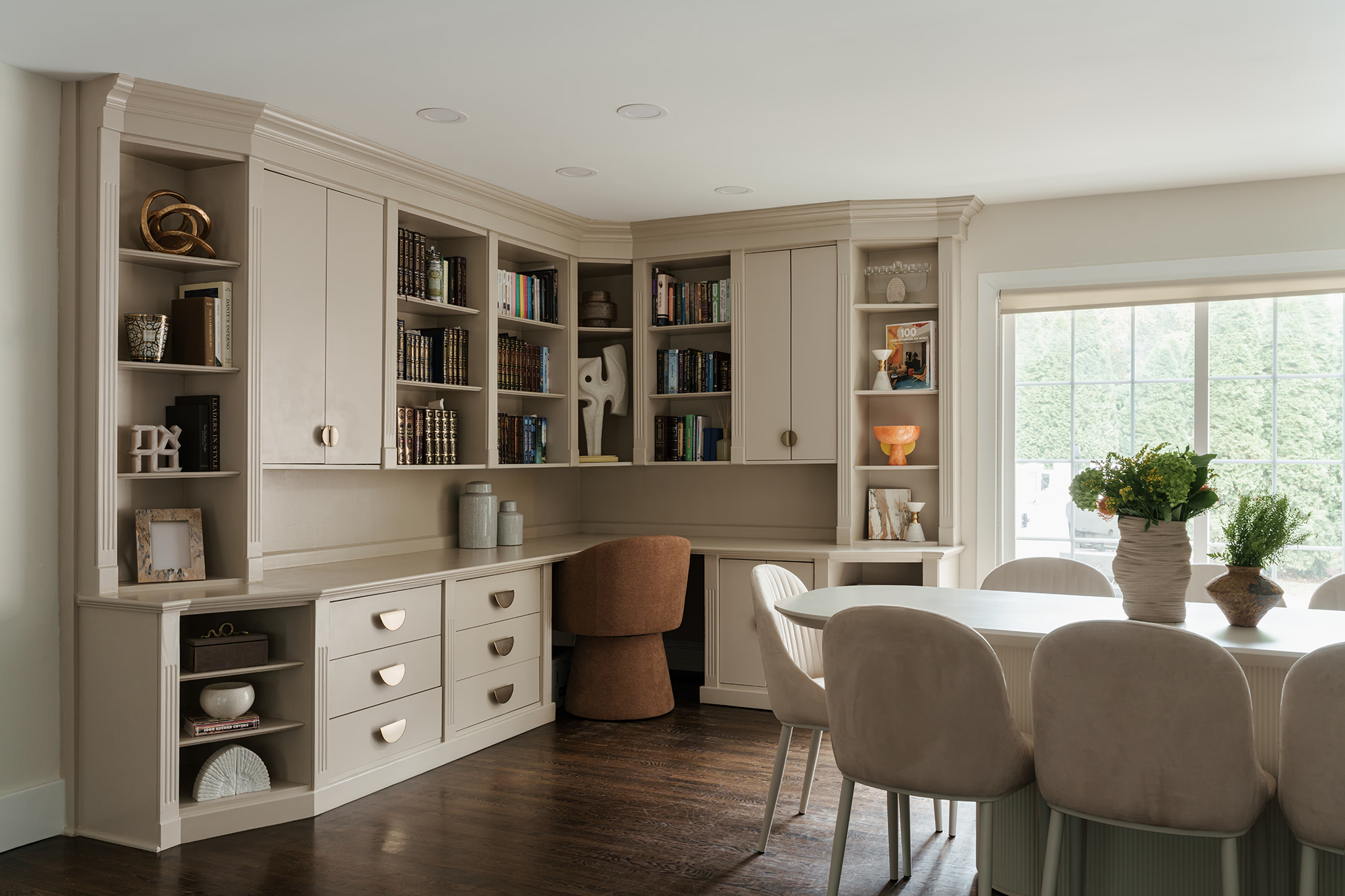
To truly blend the old with the new, bespoke millwork is essential. We often design custom library shelving or media units that "float" within the room, stopping just short of the original crown moldings. This preserves the architectural perimeter while providing the storage and functionality a modern New Yorker requires.
Renovating a pre-war apartment is an act of stewardship. By choosing the right prewar details to keep and thoughtfully integrating new finishes, you create a home that is uniquely New York. The result is a space that doesn't just look like a designer showroom, but feels like a curated collection of your life—balanced with Parisian elegance and the effortless comfort of modern livability.
In NYC, restoring original plaster moldings is usually more expensive due to the specialized labor involved. However, the aesthetic and resale value they add often outweighs the initial cost compared to installing "flat" modern alternatives.
If the wood planks are at least 3/4 inch thick, they can usually be sanded and refinished. If the "tongue and groove" is visible or the wood is paper-thin from previous sandings, it may be time for a replacement.
It depends on whether the wall is load-bearing. Most pre-war buildings use structural steel or thick masonry walls. You will need an architect or structural engineer to determine if a wall can be removed, and you will likely need Co-op board approval.
For a modern look, we recommend a "gallery white" (like Benjamin Moore Chantilly Lace). Painting the walls, baseboards, and moldings the same color creates a seamless, sophisticated look that emphasizes texture over contrast.
Pre-war ceilings are often solid concrete or plaster, making recessed lighting difficult. We recommend using high-end track lighting, wall sconces, or "floating" false ceilings in specific areas, such as the kitchen, to house modern fixtures.
If they are drafty or single-pane, replacement is recommended for energy efficiency. However, in many NYC buildings, you must match the original "light cut" and frame color to maintain the building's facade integrity.
A full renovation of a 2-bedroom pre-war apartment in NYC typically takes 6 to 9 months, including the 2-3 month period required for Co-op board approvals and DOB permitting.






.svg)