


Custom Millwork Budgeting NYC: What Drives Cost and How to Value Engineer Without Cheapening
Last Updated:
August 16, 2026
Most NYC apartment owners don't fully understand why their millwork quote is higher than expected. A built-in media unit lands at $18,000; a walk-in closet comes in at $32,000; a kitchen with painted cabinetry hits $75,000 before appliances. The numbers are real, but without understanding what's inside them, it's impossible to know where a conversation about value engineering is worth having and where it isn't.
Custom millwork in Manhattan runs, on average, $300 to $800 per linear foot, depending on wood species, finish complexity, and hardware. Full kitchen builds typically range from $50,000 to $120,000, and a well-appointed walk-in closet generally falls between $15,000 and $40,000. These are not inflated numbers. They reflect the compounded cost of skilled fabrication, specialty materials, and the very specific conditions of renovating in New York City. But they're also not immovable.
An interior designer who understands both the craft and the budget can find meaningful reductions in the right places, leaving the final result looking no different from something that cost 30% more.


Off-the-shelf cabinetry is manufactured in fixed increments (standard widths, depths, and heights) then assembled on-site with filler strips covering whatever doesn't fit. It's engineered for the average space, which means it rarely fits yours.
Custom millwork is designed around your exact dimensions, ceiling height, architectural idiosyncrasies, and finish palette. It's built in a shop, finished off-site in many cases, then delivered and installed as a complete unit.
The distinction matters specifically for NYC apartments. Pre-war co-ops often have walls that aren't plumb, floors that aren't level, and rooms with ceiling heights, radiator placements, or column positions that make standard cabinetry functionally useless. Semi-custom cabinetry, a middle tier that allows some dimensional flexibility within a manufacturer's existing line, can work well in newer construction with regular geometry. In a 1920s Upper West Side classic six, you're almost always looking at true custom cabinetry.
There's also a resale argument. Buyers in the $2M+ market have seen enough renovations to immediately distinguish custom work from builder-grade. Millwork that fits the architecture, uses quality materials, and is properly finished signals the overall quality of a renovation.
Understanding where the price comes from is the prerequisite for any intelligent conversation about where to pull back.
Material selection is usually the most visible cost driver and the one with the widest range of options. The material category breaks down roughly as follows:
After material, finish is usually the second-largest cost driver and is frequently underestimated.
A simple painted finish on MDF requires priming, sanding, and two coats of paint. A hand-rubbed oil finish on rift-cut white oak requires multiple applications, drying time between coats, and final buffing. A high-gloss lacquer, which is still requested for certain contemporary kitchens, requires a spray environment, multiple coats, sanding between each, and a flat-free drying setup that adds both time and cost.
Specialty finishes, including limewash, fumed oak, or custom-matched stains, add a premium for both the material process and the shop time required. In every case, finishing complexity compounds material cost rather than replacing it.
Complexity in joinery and form is where skilled shop time accumulates the fastest. Straight, rectilinear millwork (flat-panel cabinets, clean reveals, consistent profiles) is less labor-intensive than curved elements, fluted panels, integrated cove lighting, or multi-axis corner solutions. Each radius corner can add 25-40% to the cost of that component. Integrated features like pull-out drawer systems with custom hardware, hidden charging stations, or built-in lighting require additional coordination and components.
The design decisions made during the planning phase have a direct and significant impact on the final fabrication quote. Simplifying a profile, reducing the number of glass inserts, or shifting from a fluted detail to a plain stile-and-rail door can reduce cost without visibly downgrading the final result.
Hardware is one of the highest cost-per-line-item categories in a millwork project and one of the easiest to underestimate.
European soft-close hinges are nearly universal in quality cabinetry. Beyond that, drawer slides range from basic undermount to full-extension with built-in dampers. Pull and knob selection can add thousands to a kitchen alone. Simple cast hardware can cost $8 each while architectural pieces from Waterworks, Rocky Mountain Hardware, or specialty European lines cost $80-200+ per piece.
The design calculus here is straightforward: hardware is touched every day, and cheap hardware announces itself immediately in how it feels. This is one category where value engineering requires care.
This cost layer is specific to renovating in New York City and is often absent from general millwork pricing guides.
Co-op and condo buildings impose work-hour restrictions which limit the number of billable hours a crew can complete per day. Buildings with freight elevator schedules limit when large millwork pieces can be moved through the building and installed, sometimes requiring multiple delivery sequences rather than one.
Insurance minimums of $1-2 million per contractor are standard at many co-ops, which filters out lower-cost shops. Material staging is challenging when there's no dedicated receiving area. All of this adds meaningful overhead to any NYC millwork job that doesn't exist in a freestanding house or a suburban renovation context. It's not markup, it's the actual cost of operating in this environment.
Understanding your NYC co-op renovation requirements early, before you've committed to a millwork scope, can prevent budget surprises later.
Not every room rewards the investment equally. In a NYC apartment, certain spaces produce an outsized return in daily livability, visual impact, and how the space is perceived by future buyers. See a real life example project for Brooklyn Brownstone kitchen and library millwork.
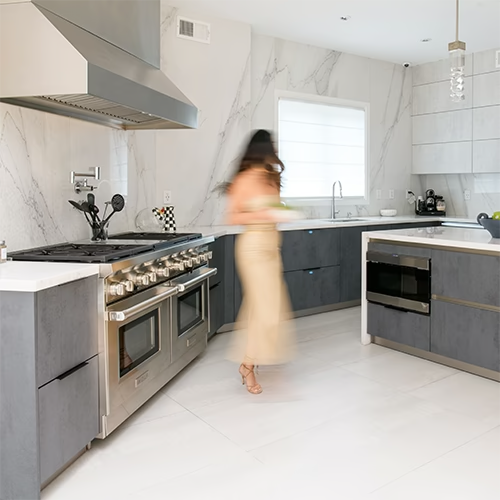
The kitchen is the highest-stakes millwork decision in any apartment renovation. The cabinetry defines the room's architectural character, withstands daily wear, and is directly evaluated by buyers.
A custom kitchen with quality materials and hardware typically runs $50,000 to $120,000 in the current Manhattan market. For apartments in the $1.5M to $3M range, a poorly executed or visibly dated kitchen is the single most common reason a buyer discounts the price.
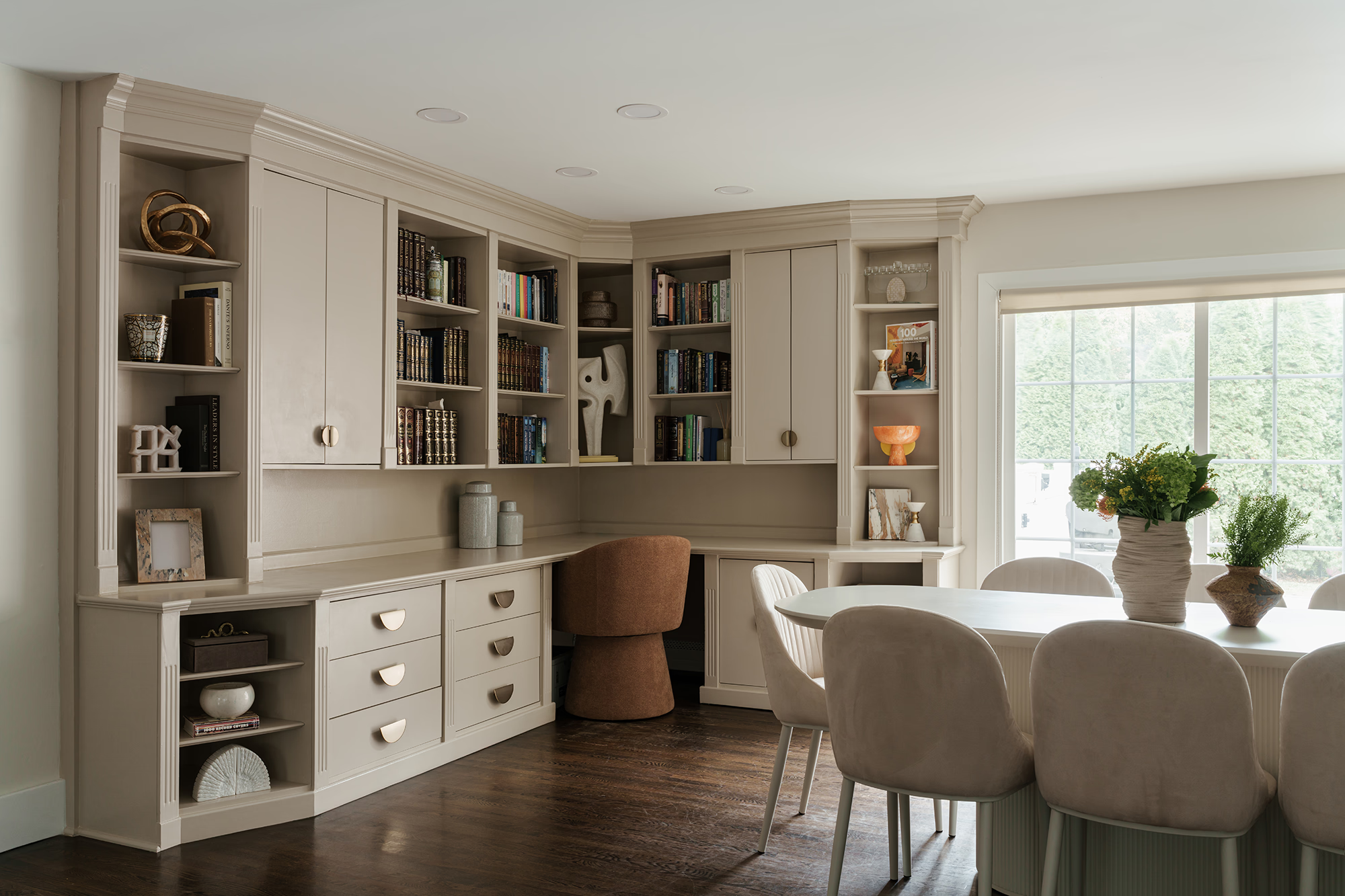
In NYC apartments, where square footage is finite, custom built-ins for bedrooms and living rooms is not a luxury addition. It is a functional necessity. A well-designed media wall or built-in library that uses the full ceiling height and integrates lighting can make a room feel architecturally intentional rather than furnished. These pieces also travel with the apartment and are among the features most consistently cited in listing descriptions as differentiating.
A custom walk-in closet or well-designed primary dressing room is one of the more requested upgrades in New York apartments. The functional benefit is obvious in small spaces. The design benefit is that quality closet millwork with proper hardware, integrated lighting, and considered material choices, elevates the feel of the entire primary suite. Custom vanities and storage in adjoining bathrooms compound that effect.
Not every piece of millwork needs to be built to the same specification. A guest room closet, a laundry room, or secondary storage in a utility space can use lower-specification materials and hardware without meaningfully affecting how the apartment reads overall. The interior designer's job is to identify how the pieces that will be seen, touched, and photographed every day versus those that won't.
Value engineering is not the same as cost-cutting. Cost-cutting removes things. Value engineering identifies opportunities to maintain function and aesthetic quality at lower cost by making deliberate decisions early. This is usually performed at the design stage, before shop drawings are finalized and materials are ordered. Once fabrication begins, changes become expensive.
Here are the specific moves that consistently produce savings without visibly cheapening the result.
For cabinetry with doors (such as kitchen cabinets, library cases, closets) the interior carcass is rarely visible. Using paint-grade MDF or poplar for the box interior while reserving the stain-grade material for doors and exposed face frames keeps material costs reasonable. For anyone opening a cabinet, the interior is the same as in a fully stain-grade build. The visual hierarchy is preserved at a meaningfully lower material cost.
The difference between a flat-panel door and a minimal shaker door is, to most observers, approximately nothing. The difference between a shaker door and a fully detailed raised-panel door is significant in shop time and material. Working with your designer to audit every profile in the millwork package routinely produces 10–20% reductions in the fabrication quote without any visible degradation in the final result.
Custom millwork doesn't mean every piece must be a different size. Cabinets built in a repeated module are easier to fabricate than a mix of widths, each requiring a separate setup. Where the layout permits, standardizing dimensions reduces shop time without compromising the piece's custom character.
Drawer hardware is worth the investment in quality. Pulls and knobs on visible cabinetry are worth selecting carefully. Hardware in secondary locations (inside pantries, on infrequently used storage doors) is a reasonable place to pull back to a mid-tier specification. This distinction allows for a mixed hardware strategy that doesn't compromise the experience of the spaces you use daily.
The highest-value approach to millwork budgeting is room-level prioritization: decide where the apartment's identity lives and resource those spaces fully. A kitchen at full specification and a guest room closet at value specification will read as a well-executed apartment. A uniform mid-level specification throughout will read as neither elevated nor intentionally designed. Your interior design process should include this hierarchy conversation before millwork scopes are drawn.
Changes to custom millwork after shop drawings are finalized (or, worse, after fabrication begins) are expensive. The clearest value engineering tool is front-loading the design process: finalizing materials, profiles, hardware specifications, and dimensional decisions before the fabrication order is placed. An experienced designer who understands your budget can flag cost-intensive decisions at the design stage, when changing them is straightforward, rather than at the change-order stage, when it isn't.
This is closely connected to understanding your renovation team and ensuring your designer, GC, and millwork fabricator communicate clearly about budget parameters from the start.
Custom millwork typically accounts for 15-25% of the total hard-cost budget in a full apartment renovation. For a 1,000-square-foot apartment with a renovation budget in the $400,000-$500,000 range, that suggests a millwork allocation of $60,000–$125,000, including kitchen cabinetry, living room built-ins, and closets.
For luxury renovations above $500 per square foot, which can run to $800 or more for fully custom work with premium materials, millwork costs scale proportionally.
These aren't rules; they're planning benchmarks. The mix of millwork-heavy versus millwork-light rooms shifts the allocation significantly. A renovation centered on a highly designed kitchen and a custom library will allocate more here than one where the priority is bathrooms and flooring. NYC interior design projects vary considerably in scope and mix, and the budget should follow the design priorities rather than the other way around.
What matters most is understanding the relationship between early design decisions and final cost, and having a designer who can help you navigate that relationship before you're committed to a spec you can't afford to change.
Custom millwork in New York City typically ranges from $300 to $800 per linear foot, depending on the wood species, finish type, hardware selections, and design complexity. Paint-grade work on simpler profiles lands at the lower end; stain-grade hardwoods with multi-step finishes and premium hardware push toward the top of that range. NYC-specific logistics such as building insurance requirements, freight elevator scheduling, limited work hours in co-ops, add additional costs.
Stock cabinetry is manufactured in fixed, standardized dimensions and is available off the shelf. Semi-custom cabinetry allows some dimensional flexibility and finish customization within a manufacturer's preset framework. Custom millwork is designed from scratch to the exact dimensions, finish, and detail of a specific project. It has no preset constraints. In NYC apartments, especially pre-war buildings with non-standard geometry, custom cabinetry is often the only option that fits and functions properly.
Yes, strategically. Semi-custom cabinetry from quality manufacturers can be used in secondary spaces where the geometry is more regular, and the finish requirements are simpler (a guest room closet, a home office built-in, a mudroom). In kitchens and primary living spaces that buyers will see and evaluate, custom millwork typically yields noticeably better results.
Value engineering means making deliberate, design-stage decisions to reduce cost without reducing the function or visible quality of the finished work. In millwork, this usually involves material substitutions in non-visible locations, profile simplifications, hardware-tier adjustments in secondary applications, and dimension standardization to reduce shop setup time. The key is that these decisions are made before fabrication, when they're cost-free.
Co-ops typically impose stricter operational constraints that add to the overhead cost of any millwork project. They have more limited work hours, more demanding contractor insurance minimums, and more involved board approval processes. Condos are generally more flexible, but still require adherence to house rules around deliveries and freight elevator use. Either way, the renovation permits and building-specific requirements are part of the cost structure and should be factored into the budget from the start.
Lead times vary by shop and project complexity, but fabrication for a full kitchen typically takes 8–14 weeks from the signing of drawings. Delivery and installation for custom millwork add 1-3 weeks, depending on the scope. Building scheduling constraints, particularly in co-ops with restricted access to freight elevators, can extend installation timelines. Planning the millwork schedule early is one of the most important factors in keeping the overall renovation timeline on track.







.svg)